
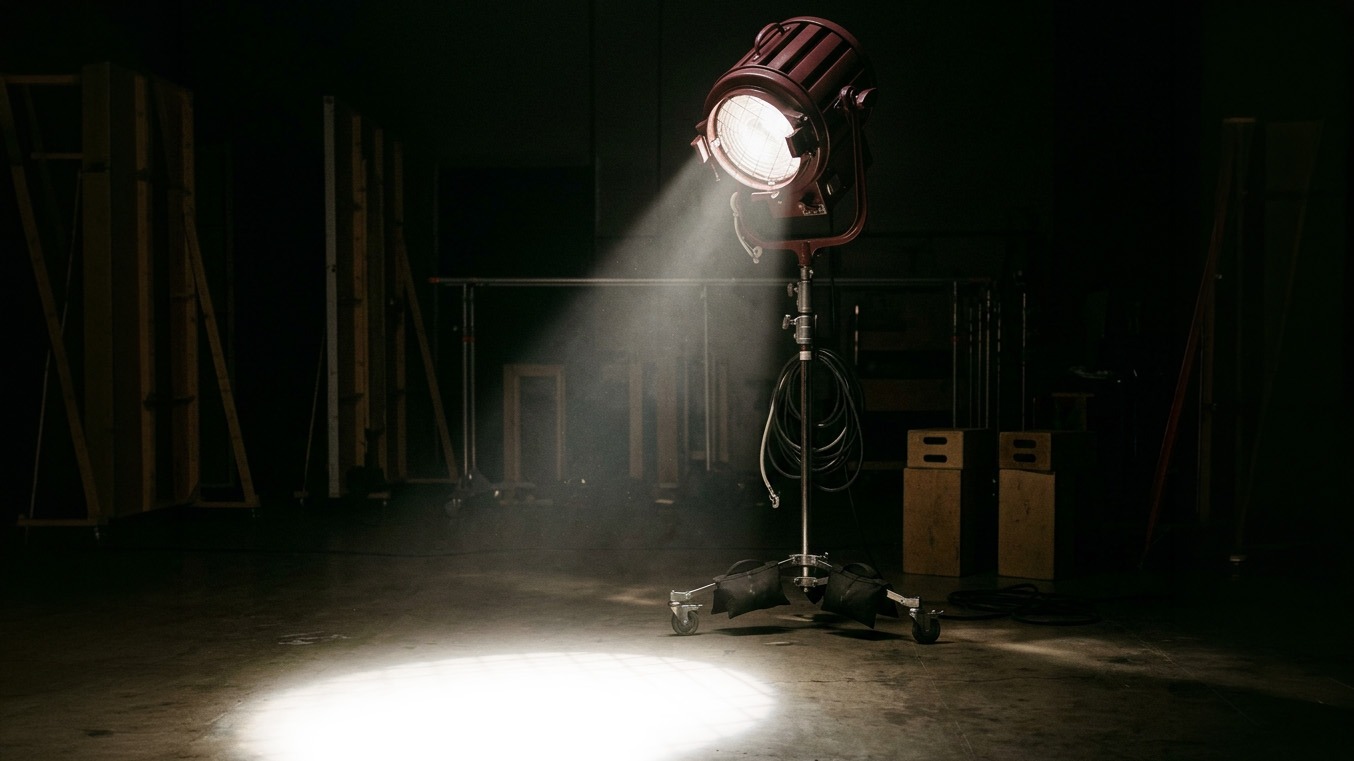
A Practical Guide for Filmmakers
There is a moment on every film set — often during the first lighting setup of the day — when a gaffer or director of photography says something like: “We need to get that light closer.” The camera operator nods. The production designer winces. The director shrugs. But nobody explains why. The reason, nearly every time, is the inverse square law. If you have spent any time on a film set without fully understanding this principle, this guide is for you.
Understanding the inverse square law will not just make you a better gaffer or DP. It will change the way you think about every lighting decision you make — from a simple interview setup to a large-scale exterior night scene.
What Is the Inverse Square Law?
The inverse square law is a principle of physics that describes how the intensity of light (or any radiated energy) falls off as it travels away from its source. In plain English: the further you are from a light source, the much dimmer it gets — and not in a simple, linear way.
The formula is:
E = S / d²
Where E is the illuminance (the amount of light hitting a surface), S is the intensity of the source, and d is the distance between the source and the surface. The key insight is that d is squared. That is what makes this law so dramatic in practice.
Here is what that squaring actually means for you on set:
- Double the distance from your subject — you get one quarter of the light (not half).
- Triple the distance — you get one ninth of the light.
- Move ten feet away instead of five — you get one quarter of the light you had at five feet.
This is not a gentle fade. This is a cliff.
Why Does This Happen?
Imagine your light source as a single point emitting energy in all directions. That energy radiates outward in an ever-expanding sphere. As the sphere grows larger, the same amount of total energy has to cover a larger and larger surface area. Specifically, the surface area of a sphere grows with the square of the radius (A = 4πr²). So when you double the radius — when you move twice as far from the light — the energy now has to cover four times as much area. Each square metre of that surface receives one quarter of the energy it did before.
This is not a quirk of photography or cinema. It is fundamental physics. It applies to sound, radio waves, gravity, and radiation — anything that radiates from a point source into three-dimensional space.
What This Means on a Film Set
The Close Light Advantage
The single most important practical takeaway is this: moving a light closer to your subject is far more powerful than making the light brighter. This has huge implications for both exposure and, more importantly, the quality and character of the light.
Consider a 1,200-watt HMI positioned ten feet from your subject. If you move it to five feet, you have not simply doubled the light — you have quadrupled it. That is a two-stop increase in exposure, achieved without touching a dimmer or changing a globe. The reverse is equally true: if a light is accidentally pushed back from five feet to ten feet on a long shoot day, your exposure drops by two full stops. This is why careful attention to light-to-subject distance is non-negotiable on a professional set.
Light Falloff and the Look of Your Image
The inverse square law does not just affect exposure — it shapes the entire visual character of your image. Specifically, it governs how quickly light falls off from your subject into the background.
When a light is placed close to a subject, the distance ratio between the subject and the background is large. Say your subject is two feet from the light and your background is twelve feet from the light. The light reaching the background is (2/12)² = about 1/36th of what hits your subject. The background goes dark. You get that dramatic, intimate, Rembrandt-style falloff beloved by noir cinematographers and portrait photographers alike.
Now move that same light back to twenty feet from the subject, with the background at thirty feet. The ratio is now (20/30)² = about 4/9ths. The background receives nearly half the light the subject does. The image looks flatter, more even, more “commercial.” Neither look is right or wrong — but you need to understand the inverse square law to control which one you get.
The Source Size Relationship
Here is where the inverse square law intersects with another fundamental principle: the apparent size of a light source relative to the subject determines the softness of shadows.
A large softbox placed close to your subject appears as a large light source — it wraps around the subject and produces soft, gradual shadow transitions. Move that same softbox further away and it begins to behave more like a small, hard source. The physical size has not changed, but its apparent size relative to the subject has shrunk. Combined with the intensity falloff described above, this means that moving a soft source away from your subject simultaneously makes the light harder and dimmer. Moving it closer makes it simultaneously softer and brighter. This is one of the most useful creative levers available to a cinematographer.
F-Stops and the Inverse Square Law
For those working with photographic exposure, the inverse square law maps directly onto the f-stop scale. Because f-stops are defined so that each stop represents a halving or doubling of the light reaching the sensor, and because intensity falls off with the square of distance, every time you double your distance from a light source you lose exactly two stops of exposure.
Conversely, to maintain the same exposure as you move a light further away, you must open your aperture (decrease the f-number). Moving from f/8 to f/4 opens the lens by two stops, compensating for the fourfold light loss that occurs when you double the distance. This is why the required f-stop decreases as distance increases: a smaller f-number means a larger aperture opening, admitting more of the available — but now diminished — light.
Common Scenarios and How to Think Through Them
Lighting Two Subjects at Different Depths
One of the most common lighting challenges in narrative filmmaking is placing two subjects at different distances from the key light and getting them to read as similarly exposed. Because of the inverse square law, the subject closer to the light will always be significantly brighter unless you compensate.
Your options are: move the light further back (reducing the intensity differential between the two distances, though also making both subjects dimmer and the light harder); use a separate fill or accent light on the more distant subject; or accept the differential and use it dramatically, placing the more important character in the brighter position.
Matching Shots Across a Scene
When shooting coverage — a wide, then a medium, then close-ups — camera position changes but lighting often stays the same. The inverse square law is stable: if your lights stay in position, your exposure should remain consistent between setups as long as the subject-to-light distance does not change. The danger comes when lights are nudged or repositioned between setups without measurement. A light moved back even two feet can drop a half-stop or more, and that inconsistency will be visible in the edit.
Working with Large Sources and Practicals
Practical lights — the table lamps, overhead practicals, and candles that appear in frame — are subject to the inverse square law just like any other source. Candles in particular demonstrate the law vividly: an actor lit by a candle at arm’s length (roughly two feet) will be dramatically brighter than anything at six feet, because the light at six feet is only (2/6)² = 1/9th the intensity. This is what gives candlelight its intimate, enveloping quality and its dark, falling-off backgrounds.
Quick Reference: Distance vs. Relative Intensity
The table below shows how intensity changes relative to a baseline of 1,000 foot-candles at one foot. These numbers assume a point source in open space — real-world fixtures with reflectors and modifiers will differ, but the ratios hold as a reliable approximation.
Distance Intensity Relative to 1 ft Exposure change
1 ft 1,000 fc 100% Baseline
2 ft 250 fc 25% −2 stops
4 ft 62.5 fc 6.25% −4 stops
5 ft 40 fc 4% −4.6 stops
10 ft 10 fc 1% −6.6 stops
20 ft 2.5 fc 0.25% −8.6 stops
The Most Important Thing to Remember
The inverse square law is not a constraint to work around — it is a creative tool. The dramatic portraits of Caravaggio and Rembrandt were not accidents; those painters understood implicitly that a light source close to the subject, with deep space behind it, would produce a characteristic falloff into darkness. Every single Hollywood cinematographer working with a key light close to an actor and a dark background is using the same principle.
Know the law. Use it deliberately. The moment you stop fighting the physics and start designing with it, your lighting will take on a confidence and intentionality that is immediately visible on screen.